✦ HoodServe Blog
Business Growth
Why Every Service Business Needs a CRM in 2026
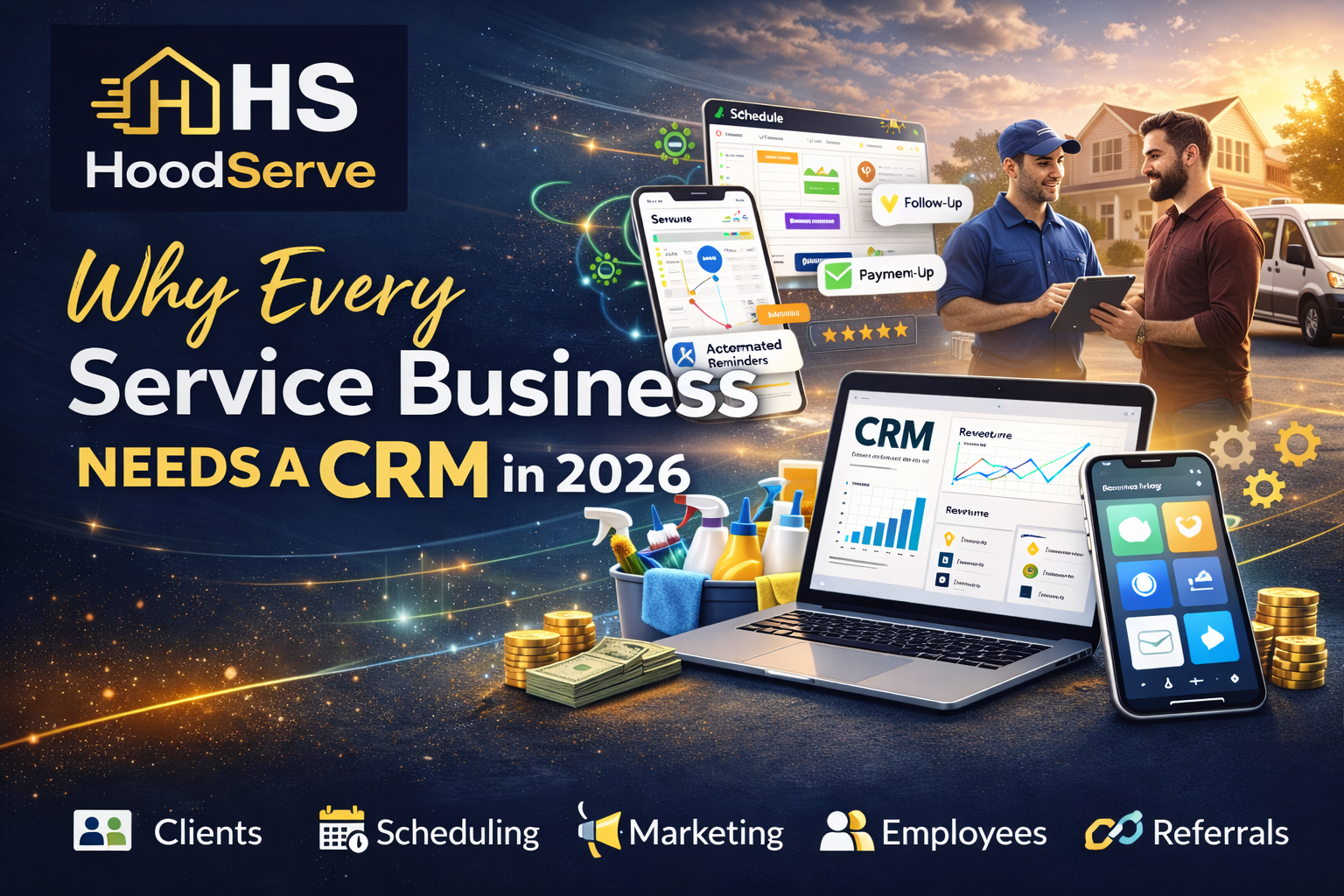
The service industry has changed dramatically over the last decade. Customers expect faster communication, reliable scheduling, and a more professional experience from local service providers.
Whether you run a cleaning company, lawn care service, handyman business, or home repair company, managing clients and jobs manually is becoming increasingly difficult.
This is why more service businesses are adopting CRM software. In 2026, a CRM is no longer just a tool for large companies—it has become an essential system for small and growing service businesses.
A CRM (Customer Relationship Management system) is software designed to help businesses manage their customers, communication, and service operations in one centralized place.
Instead of tracking clients across spreadsheets, notebooks, and text messages, a CRM keeps everything organized.
Service businesses use CRM platforms to:
With the right CRM system, business owners can run their entire operation from one dashboard.
Many service businesses start by managing their operations manually. They rely on notebooks, spreadsheets, phone calls, and text messages to coordinate jobs.
This approach works at the beginning, but it quickly becomes inefficient as the business grows.
Common problems include:
Without a centralized system, it becomes harder to scale your business.
One of the biggest advantages of a CRM is the ability to store all client information in one place.
This includes:
Having this information easily accessible allows businesses to provide better customer service and avoid mistakes.
Scheduling is one of the most important parts of running a service business.
A CRM with scheduling tools allows business owners to:
This ensures jobs are completed efficiently and on time.
Customers expect quick communication from service providers. However, manually sending messages to every client can become overwhelming.
CRM platforms automate communication by sending:
Automation ensures that customers stay informed without requiring extra work from your team.
As service businesses grow, managing employees becomes more complex.
A CRM system can help track:
This allows managers to coordinate teams more effectively and avoid miscommunication.
Customer retention is one of the most important factors for long-term success.
CRM systems help businesses maintain relationships with clients through:
These tools help businesses encourage repeat bookings and long-term customer loyalty.
Many service businesses grow through referrals and local marketing.
CRM platforms allow businesses to track where new clients come from and manage referral programs automatically.
This allows owners to see which marketing efforts are producing the best results.
If you're interested in referral growth strategies, read:
How to Get Your First 20 Cleaning Clients Without Paying for Ads
Customers trust businesses that appear organized and professional.
CRM systems help create a more professional experience by providing:
These small details make a big difference in how customers perceive your business.
Technology has become an essential part of running a competitive service business.
Companies that rely on manual systems often struggle to keep up with businesses that use modern tools.
CRM platforms allow service companies to operate more efficiently while delivering better customer experiences.
In 2026, businesses that adopt these systems will have a significant advantage over competitors that continue to rely on outdated processes.
Running a successful service business requires strong organization, clear communication, and efficient operations.
A CRM system brings all these elements together in one place.
Platforms like HoodServe help service businesses manage clients, employees, scheduling, referrals, and marketing from a single system.
If you want to scale your service business and stay competitive in 2026, implementing a CRM is one of the smartest decisions you can make.
The all-in-one platform for service businesses. No credit card needed.
Start free trial →